We Launched Celeste Naturals Before We Were Ready — Here’s What Happened
Chrissy and I spent more than a decade in corporate consulting. In that world, you do not put anything in front of a client until it has been reviewed, revised, aligned, re-reviewed, and blessed by at least three people with “senior” in their title. If we had ever walked into a client meeting with something as rough as what we launched Celeste Naturals with, we would have been fired. Possibly escorted out.
We launched anyway. Everyone tells you done is better than perfect. Consider this a field test of that advice, run with our own money.
What “not ready” looked like for us
By 2024 we had spent months on product development and landed on soap formulas we were, generously, “okay” with. Not proud of. Okay with. We’ve made formula tweaks since then, which tells you everything about where they were at launch.
Everything around the product was worse. We didn’t love our packaging. Our website was in its infancy, and I’m being kind to the website. We had never worked a market in our lives. Our combined retail experience amounted to high school jobs decades ago, selling someone else’s products. Selling something you made yourself, it turns out, is a different animal entirely.
Every instinct from our consulting years said the same thing: this is not client-ready. Go back, refine it, come back when it’s polished.
Why we launched anyway
Two reasons, one practical and one that took us longer to admit.
The practical one: everything we make is sensory. We launched with soap, sugar scrubs, a lotion stick, and a couple of candles, and not one of those sells from a spreadsheet. People pick things up, they smell them, they make a face (good or bad), and that face tells you more than any survey ever will. We could not learn what we needed to learn from behind a laptop. We had to get our products in front of actual noses.
The harder one to admit: the polish we kept waiting for was never coming. We had spent over ten years getting good at consulting. We had spent months at soap. Of course the work didn’t meet our standards. Our standards were calibrated to a completely different career. Waiting until the new thing felt as polished as the old thing meant waiting forever, because that feeling wasn’t a milestone we could reach. It was a memory of expertise we hadn’t built yet.
So we accepted the lumps in advance and went.
What actually happened
Not triumph. Not disaster. Something much more useful: information.
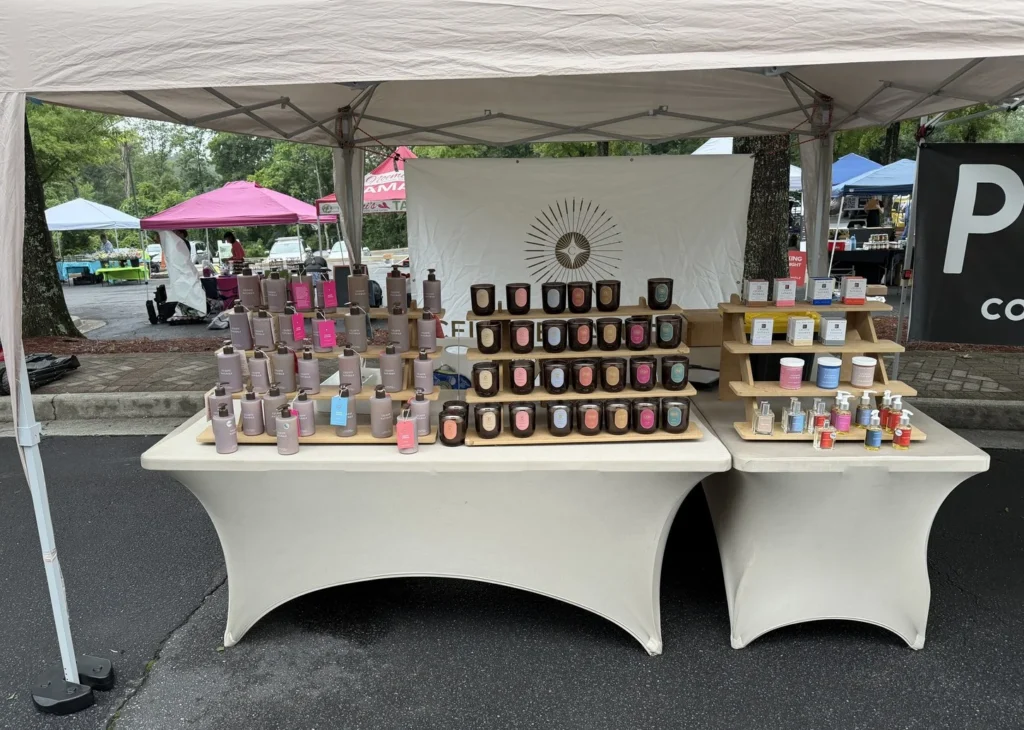
Some of it stung. Our packaging turned out to be hard to read for a decent chunk of people, which is the kind of thing you simply cannot discover from your own kitchen table, because you already know what the label says. Our display was a couple folding tables doing their best, with everything crammed onto flat, white tablecloths. And not every scent landed. Looking at you, Espresso. We loved you. The market did not.
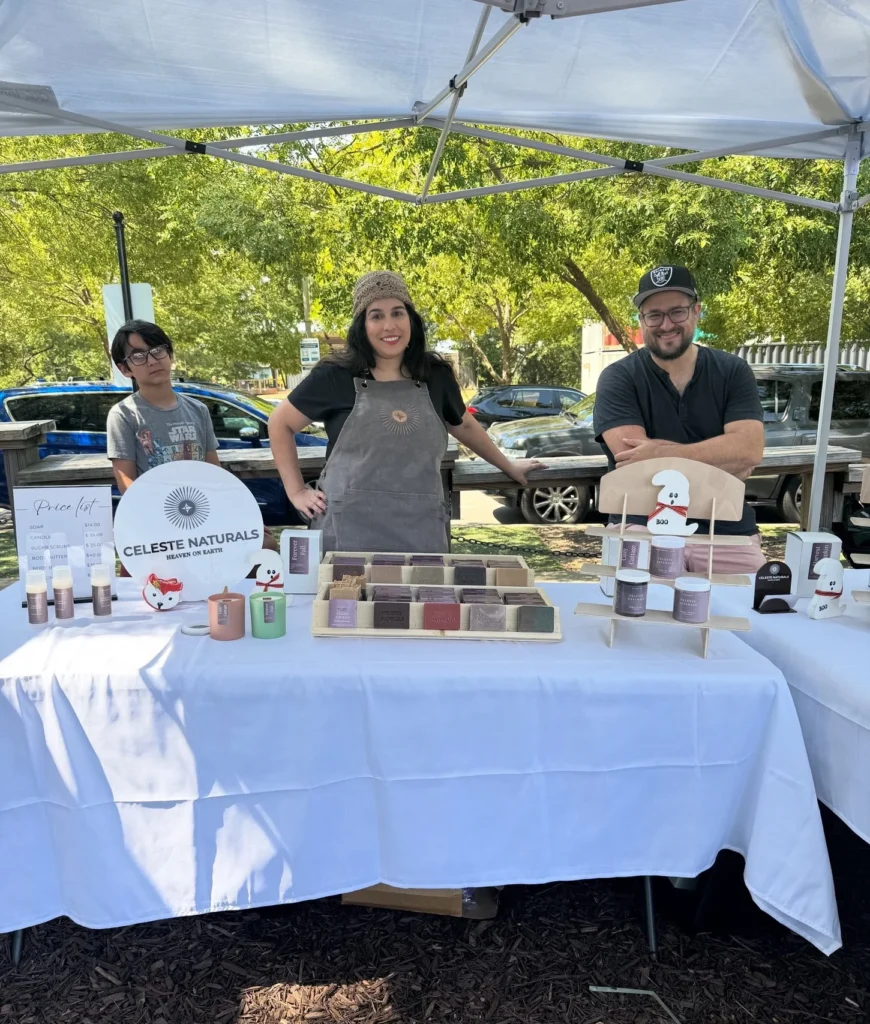
But here’s what we braced for that never came: rejection. We had spent so long worried that putting out flawed work meant customers would write us off. Instead, people bought things. People came back. People told us which scents they wanted more of and squinted at our labels in a way that told us exactly what to fix. The reception wasn’t rapturous, but it wasn’t negative, and it turns out “not negative plus specific feedback” is worth more to a new business than applause.
We even turned a profit at that first market. Not a big one. Nobody was retiring on it. But strangers handed us real money for things we made, at a table we were half convinced wasn’t ready to exist, and that did more for our motivation than any amount of prep work ever had.
That was the trade we didn’t understand until we made it. We gave up the fantasy of a flawless launch and got back something better: proof that we could survive contact with the public, and a to-do list written by actual customers instead of our own anxiety.
“Fail fast” only counts if you let yourself fail
Everyone in business loves saying “fail fast.” We said it plenty in our consulting days, usually on a slide, usually about someone else’s organization.
What nobody mentions is that failing fast has a prerequisite: you have to actually give yourself the chance to fail. Sitting at home reworking your packaging for the fourth time is not failing fast. It’s not failing at all, which sounds like a win but isn’t. It’s just deferring every lesson to some future date while your confidence quietly erodes.
The version of us that waited another six months would have launched with slightly better packaging that was probably still hard to read, because we didn’t know legibility was a problem. We would have brought Espresso anyway, because we didn’t know it was a dud. Nearly everything wrong with our launch was in the category of things we could not have known in advance. The only way through that category is through it.
The sooner you accept that you can’t know everything, and that you definitely don’t know what you don’t know, the faster you can start making actual progress instead of theoretical progress.
Done is better than perfect, if you’re sitting on a launch
If you’re a small business owner circling a launch date and finding one more thing to fix first, we’ve been you, so take this in the spirit it’s intended.
Your standards are probably imported from somewhere else. Ours came from consulting. Yours might come from a corporate job, a design background, or just a decade of consuming other people’s finished products. Finished products are what version forty looks like. You’re comparing your version one to everyone else’s version forty, and version one is losing a rigged game.
The flaws you’re obsessing over and the flaws that matter are different lists. We fussed over the website. Customers cared that the label was hard to read. You don’t get to find out which list is which until strangers interact with the real thing.
And the fear that flawed work will get you rejected is mostly wrong. What we found on the other side of launching wasn’t embarrassment. It was encouragement, momentum, and enough real feedback to evolve faster in a few markets than we had in months of preparation.
We named this blog The Enemy of Good for a reason. Perfect wasn’t protecting us. It was just standing between us and everything we needed to learn.
The product got better because we launched. The packaging got better because we launched. We got better because we launched. None of it was ready, including us, and that turned out to be fine.
Espresso, though. Espresso was never going to make it.